Partner Persis Addy, Lucy Anthony
Queer Places:
Boston University, 745 Commonwealth Ave, Boston, MA 02215, United States
Albion College, 611 E Porter St, Albion, MI 49224, Stati Uniti
240 S Ridley Creek Rd, Media, PA 19063, USA
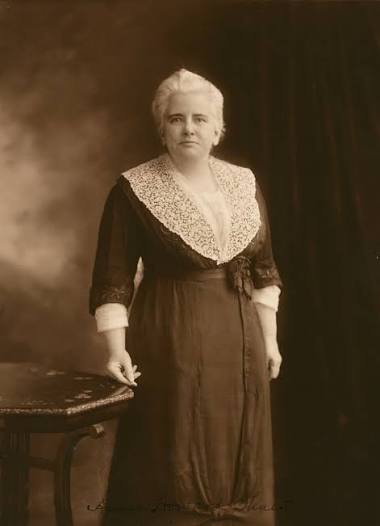 Anna Howard Shaw (February 14, 1847 – July 2, 1919) was a pioneering leader of the women’s suffrage movement, a physician, and one of the first ordained female Methodist
ministers in the United States. Renowned as a charismatic orator and international movement leader, she served for eleven years as the president of the National American
Woman Suffrage Association (NAWSA). Throughout her life, she also built deeply significant romantic partnerships with women, maintaining a lifelong commitment to both her
public cause and her domestic happiness.
Anna Howard Shaw (February 14, 1847 – July 2, 1919) was a pioneering leader of the women’s suffrage movement, a physician, and one of the first ordained female Methodist
ministers in the United States. Renowned as a charismatic orator and international movement leader, she served for eleven years as the president of the National American
Woman Suffrage Association (NAWSA). Throughout her life, she also built deeply significant romantic partnerships with women, maintaining a lifelong commitment to both her
public cause and her domestic happiness.
Born in Newcastle-upon-Tyne, England, on February 14, 1847, Shaw emigrated to the United States with her family at age four, initially settling in Lawrence,
Massachusetts. When she was twelve, her father claimed 360 acres of wilderness land in northern Michigan and sent his wife and five young children to live there alone while
he remained in Massachusetts participating in the abolitionist movement and other public causes.
Expecting a picturesque English farm, the family arrived instead to find a desolate log cabin 40 miles from the nearest post office and 100 miles from a railroad. While
her mother suffered severe shock and despair, young Shaw shouldered immense physical burdens to keep the family alive—felling trees, chopping firewood, and digging a well.
During the Civil War, after her older brothers and father enlisted, fifteen-year-old Shaw became a schoolteacher to help cover the family's growing financial deficits.
Resenting her father's lack of foresight for his family's survival, she developed a fierce self-reliance that shaped the rest of her life.
After the Civil War, Shaw moved to Big Rapids, Michigan, working as a seamstress while holding a steadfast drive to attend college. Inspired by Reverend Marianna Thompson
and encouraged by her high school preceptress, Lucy Foot, Shaw discovered a natural talent for public speaking. At age twenty-four, despite having previously preached only
"to a congregation of listening trees" in the forest, she delivered her first official sermon in Ashton, Michigan.
When her family threatened to withhold all financial support if she pursued the ministry, Shaw refused to back down. Encouraged by the prominent lecturer Mary A.
Livermore—who told her, "No matter what people say, don’t let them stop you!"—Shaw officially entered Albion College in 1873, supporting herself by lecturing on
temperance.

1896 photograph of Susan B. Anthony (center) and other women's rights leaders. Shaw sits to Anthony's immediate right.

Carrie Chapman Catt and Anna Howard Shaw in 1917
In 1876, she enrolled in the Boston University School of Theology as the only woman in a class of forty-two men. She faced intense discrimination and poverty, paying
higher room rent than male students and competing fiercely for preaching assignments. Despite these barriers, she persevered, graduating and eventually achieving ordination
in the Methodist Protestant Church in 1880 after being refused by the Methodist Episcopal Church. Seeking to broaden her service, she went on to earn her medical degree
(M.D.) from Boston University in 1886.
While in medical school, Shaw turned her energy toward political rights for women. Beginning in 1886, she served as chair of the Franchise Department for the Woman’s
Christian Temperance Union (WCTU) before transitioning fully into suffrage work with the Massachusetts Suffrage Association and the American Woman Suffrage Association
(AWSA).
During the summer of 1876, while living on Cape Cod, Shaw met Persis Addy. Shaw—who would later become one of
America’s most prominent suffragists, physicians, and ordained ministers—was struggling through
severe financial hardship as the sole female student in her class of 43 at the Boston University School of Theology.
Persis recognized Shaw's extraordinary talents and invited her to live with her, offering both total financial support and emotional partnership. In autumn 1876, Persis
moved to Boston to set up a shared home with Shaw.
Shaw affectionately referred to their household as a "family of two," describing Persis as her first mature love who introduced her to a warm existence of comfort,
culture, and deep emotional trust.
Persis virtually financed Shaw’s theological studies, ensuring she could complete her degree without the threat of starvation or freezing in unheated attic rooms.
Their shared life was cut short when Persis fell ill and died in March 1878 at the age of 40.
In 1887, Shaw met Susan B. Anthony, who persuaded her to join the National Woman Suffrage Association (NWSA). Shaw played
a crucial role in negotiating the merger of AWSA and NWSA into a single unified front. In 1904, she became the president of NAWSA, leading the national organization for
eleven years.
During her presidency, Shaw maintained an unwavering commitment to non-violent, constitutional lobbying. When younger suffragists like
Alice Paul and Lucy Burns began adopting militant tactics—such as picketing the White House—Shaw firmly opposed them, holding fast to Susan
B. Anthony’s philosophy that permanent progress could only be achieved through peaceful means. She stepped down as president in 1915, passing the leadership to her ally
Carrie Chapman Catt.
During World War I, Shaw served as head of the Women's Committee of the U.S. Council of National Defense, becoming the first woman to earn the Distinguished Service
Medal. She continued lecturing tirelessly until the end of her life, delivering her famous address "The Fundamental Principle of a Republic" in 1915. In a speech at Baylor
University just months before her death, she urged women to join the fight, arguing that the only way to deny women the vote in a democracy was "to prove that women are not
people."
Throughout her life, Shaw formed deep, passionate attachments to women. While at Albion College, she shared a close bond with
Clara Osborn. During her time in Boston, she met Persis Sears Crowell Addy, a
wealthy young widow who became her first mature love. Persis provided Shaw with emotional and financial stability, and the two established what Shaw called "a family of
two." When Persis died unexpectedly in 1878, Shaw was heartbroken, memorializing her for the rest of her life.
Later, Shaw met Lucy Elmina Anthony, the niece of Susan B. Anthony. The two became life partners, sharing a
thirty-year relationship and building a country home together named Moylan in Media, Pennsylvania. Shaw deeply cherished their domestic life, once lightheartedly referring
to them as "rather a broken up couple" after Shaw broke her foot and Anthony fractured her elbow at the same time.
Shaw died of pneumonia at her home in Moylan on July 2, 1919, at the age of seventy-two, with Lucy Anthony by her side—just months before the ratification of the
Nineteenth Amendment granted women the constitutional right to vote. After Shaw's death, Anthony referred to her as "my Precious Love" and "the joy of my life."
References:
Other references:
- ^ Anna Howard Shaw, From Wikipedia, the free encyclopedia
Support this project
This website is a passion project researched, developed, and funded entirely by me. If you find the content valuable and would like to help support the ongoing research and hosting costs, any contribution is deeply appreciated.
Thank you for keeping this independent resource alive!
My books on Amazon: Elisa Rolle's books
BACK TO HOME PAGE


